

If you’re relocating to Spain, buying property, or launching a business, here’s the truth: understanding the NIE (Número de Identificación de Extranjero) timeline is crucial. The short answer is 2 to 6 weeks from booking your appointment to holding your certificate in hand. But that’s just the average—it really depends. In smaller towns like Alicante, you might wrap it up in less than two weeks. In Madrid or Barcelona? Expect to stretch toward six weeks, especially during peak seasons. The whole process breaks down into four phases: booking your appointment, preparing documents, processing, and finally collecting your NIE. Get it right from the start, and you dodge frustrating rescheduled appointments. Mess it up, and you’re back in line weeks later wondering where everything went wrong.
Why the NIE Matters More Than You Think
The NIE isn’t just another bureaucratic number to collect. It’s your tax identification number in Spain—the one you need for basically everything. Open a bank account? Need an NIE. Buy property? Need an NIE. Register a business? Hire employees? Enroll your kids in school? Every single one requires an NIE. Without it, you’re stuck. That’s why getting this process right actually matters.
Spain has two types of NIE: one for residents (people living in the country) and one for non-residents (temporary visitors, property buyers, digital nomads without permanent residency status). The timelines are pretty similar, though the paperwork differs slightly. Here’s the important part: the NIE number itself never expires. It’s yours for life. But if you’re applying for residency or getting a TIE card (the physical residence card), there are overlapping timelines that can get confusing fast. This is where a lot of people hit unexpected delays without even realizing what went wrong.
Phase 1: Booking Your Appointment (1 to 4 Weeks)
Let’s be honest: the first obstacle is often the toughest. You need a cita previa (appointment) through Spain’s online booking system. Think concert tickets—slots go live, and within minutes they’re gone. The waiting time varies wildly depending on where you’re applying.
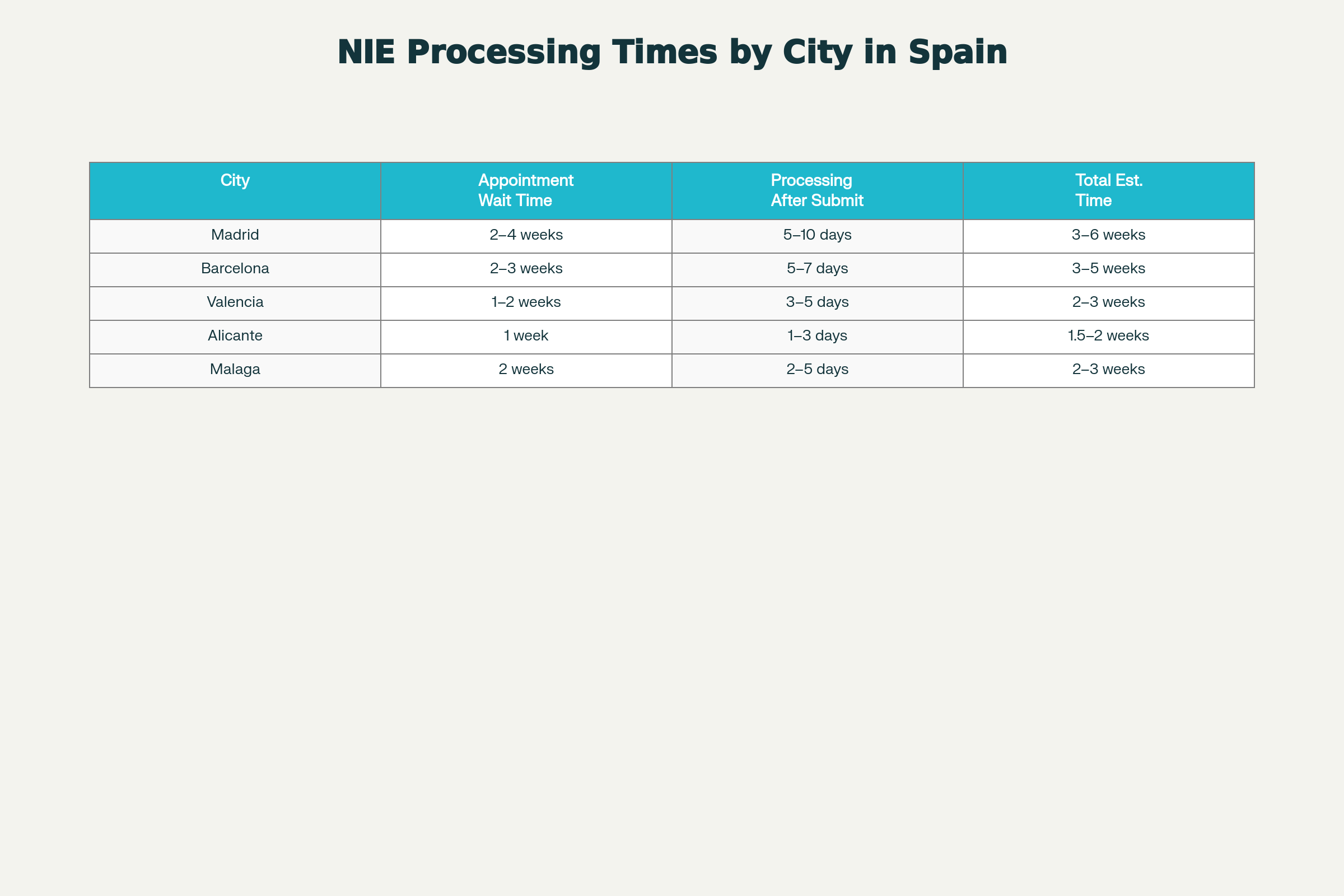
In Madrid or Barcelona, you might be looking at appointments booked 4 to 8 weeks out during peak season (summer, spring). Jump to smaller cities like Alicante or Málaga, and you could grab a slot in 1 to 2 weeks. Valencia typically runs 1 to 2 weeks. The key is starting early—like, way earlier than you think you need to. As soon as you know you’re moving to Spain, check the booking system. Even if your move is months away, book the slot. Seriously.
Here’s what people actually do: Hit the Cita Previa website Monday morning at 8 AM sharp. That’s when new slots typically appear. Refresh constantly. If Madrid and Barcelona are totally booked out, try neighboring provinces or smaller towns in the same region. You don’t have to apply where you’ll actually live—just somewhere in Spain. If the website feels like an endless nightmare (and it will), consider hiring a gestor—a local administrative agent. They often see canceled appointments before anyone else and can snag them instantly. You’ll pay €100–300, but the peace of mind is worth it.
Another option if you’re still abroad: apply through a Spanish consulate in your home country before you move. This skips the appointment booking chaos entirely. Processing takes longer (typically 4–8 weeks), but you know exactly where you stand, and you can plan your move more predictably.
Phase 2: Preparing and Organizing Your Documents (1 to 2 Weeks Before Your Appointment)
Once you’ve booked your appointment, don’t relax yet. Now comes the part that actually determines whether your application sails through or gets rejected and rescheduled: document preparation. Seriously—this phase makes or breaks everything.
You’ll need originals plus photocopies of these:
EX-15 form (the official NIE application form, filled out in Spanish, in ALL CAPS, with zero crossed-out words)
Valid passport (original plus photocopies of every page with stamps or data)
Modelo 790 payment receipt (proof you paid the NIE fee—currently around €9.84–12—at a bank before your appointment)
Proof of your purpose (why you need an NIE: job offer, property purchase contract, investment documents, whatever applies)
Proof of residence in Spain (utility bill, rental contract, or official mail with your address)
This is where most people mess up. The EX-15 form is tedious—four pages, all in Spanish, and every single field matters. Leave one blank, make one typo, forget to sign it, and you’ll be asked to rebook and come back. That’s weeks lost over something you could’ve fixed in ten minutes if you’d paid attention the first time.
Fill the form on a computer if you can—never handwrite it. Print it out and review it multiple times before your appointment. Check that your name matches your passport exactly. Check that your address is correct. Check that you’ve selected the right residency status (non-resident if you’re just visiting or buying property; resident if you’re moving there long-term). Triple-check that fee receipt—bring the original stamped by the bank, not just a photocopy.
Pro tip that actually saves you: Most applicants bring originals but forget photocopies. Here’s the problem: Spanish offices don’t have copy machines. If they ask for a copy and you don’t have it, they’ll reject your application on the spot. Bring two complete sets of photocopies of everything.
Phase 3: The Waiting Game—Processing Your Application (3 to 10 Days)
After you submit your documents at the police station or Oficina de Extranjería, the actual processing begins. This is where location becomes absolutely critical. Here’s what typically happens:
In smaller towns (Alicante, Málaga): Your NIE might be issued the same day or within 1–3 days. Seriously. You walk in with your documents, they review everything, confirm your number, and hand you a temporary certificate right there.
In mid-sized cities (Valencia): Usually 3–5 days
In major cities (Madrid, Barcelona): Typically 5–10 days
Why the huge variation? Staff workload varies wildly between offices. Summer holidays, Easter, and end-of-year periods are absolute chaos—everyone wants to finalize things before deadlines, and immigration offices are running skeleton crews. If you have any flexibility, avoid applying in June, July, August, or December.
One thing to clarify: Sometimes the office issues you a temporary certificate (basically an A4 printout with your NIE number) immediately, but the official plastic TIE card (if you’re becoming a resident) takes another 30–45 days to print and arrive. Make sure you understand what you’re actually getting that day.
(see the generated image above)
Phase 4: Collecting Your NIE Certificate (1 to 2 Days)
After processing, you’ll get notified—usually by email—that your NIE is ready for pickup. You’ll need to return to the same office, and sometimes book another appointment just to collect it. In most cases, it’s quick: show your ID, collect the document, done. Occasionally, they’ll mail it directly to you, but that’s rare.
Here’s your complete timeline snapshot:
| Step | Timeline |
|---|---|
| Booking appointment | 1–4 weeks |
| Document preparation | 1–2 weeks before appointment |
| Submission day | 1 day |
| Processing | 3–10 days (varies by city) |
| Collection | 1–2 days |
| Total | 2–6 weeks |
What Actually Speeds Things Up (and What Slows You Down)
Several factors can push your timeline in different directions:
Location is everything. Madrid and Barcelona process thousands of NIE applications yearly. They’re efficient machines, but volume creates delays. Smaller cities move faster but might have different procedures. Always check your specific city’s requirements before your appointment.
Seasons matter more than you’d think. June through August sees massive demand (expats relocating, tourists buying property). Winter is typically quieter. If you have flexibility, apply in September or October.
How complete your documentation is can make or break you. Missing even one document means automatic rejection. We’ve said this already, but it bears repeating: incomplete EX-15 forms, missing payment receipts, no photocopies—these are the biggest killers. This single factor causes more rescheduled appointments than anything else.
Your justification for needing the NIE can matter. If you’re applying under time pressure (job starts on a specific date, property closing with a deadline), bring supporting documents that prove urgency. The office may prioritize your application.
Using a gestor or immigration lawyer genuinely helps. They know which offices have faster processing. They know which staff members are organized. They grab canceled appointments before you even know they exist. It costs money (€100–300 typically), but for people relocating internationally, it’s often worth every euro.
When You Need It Faster: Fast-Track Options
If 2–6 weeks is too long—your job starts soon, your property closing is approaching, whatever—you have actual options:
Request expedited processing. If you can demonstrate genuine urgency (job offer with a start date, property purchase with a signing deadline, visa expiration), the office may speed things up. You’ll need supporting documents: the job offer letter, property contract, or visa paperwork. Some regions can issue an NIE in 24–48 hours with proper justification.
Apply through a consulate before you move. If you’re still abroad, submit your application to the Spanish consulate in your country. It takes longer (4–8 weeks), but you completely avoid the appointment booking madness and can plan your relocation more predictably.
Use professional services. Companies like FastNIE can get your NIE in 7–30 days by handling everything remotely—they arrange the power of attorney, manage all paperwork, and coordinate with Spanish offices on your behalf. Cost is higher (€300–500), but the timeline is tight and predictable.
Apply in a smaller city first, then transfer later. Technically, you can apply for your NIE anywhere in Spain, then transfer your registration later. Alicante, Córdoba, or Jaén often have faster appointment availability. Once you get your number, you can update your address afterward.
Common Mistakes That Add Weeks (And How to Avoid Them)
Knowing what not to do is just as important as knowing what to do. Here are the errors that consistently delay applications:
Incomplete or incorrectly filled EX-15 form. This single mistake causes countless rescheduled appointments. Fill it on a computer. Print it and review it three times before submission. Have someone else review it too—fresh eyes catch mistakes you’ll miss.
Forgetting or losing the Modelo 790 payment receipt. You must pay the fee at a bank before your appointment. You must bring the stamped original receipt to your appointment. No receipt = no NIE. Period. No exceptions.
Bringing originals but forgetting photocopies. The office won’t make copies for you. If a document’s copy is missing, they’ll ask you to come back. You’ll need to book another appointment and lose another 1–2 weeks.
Mismatched address information. If your EX-15 form lists one address but your proof of residence shows another, the office will ask for clarification. Avoid this by ensuring all documents match perfectly. If you’ve recently moved, get updated proof of residence before your appointment.
Applying at the wrong office or selecting the wrong appointment type. Not all appointments at the Oficina de Extranjería are for NIEs. Make sure you select “Certificado de Registro para Ciudadanos UE” (if you’re EU) or “Expedición de Tarjeta de Identidad de Extranjero” (if you’re non-EU). Booking the wrong appointment type means your slot is completely invalid.
Arriving late to your appointment. Show up late and your appointment gets canceled. You’ll need to rebook. There are no exceptions. Mark the date in your phone with a reminder. Show up 15 minutes early.
Regional Variations and Special Situations
Spain’s 17 autonomous communities each run their own immigration offices, and procedures can vary. Before your appointment, check your specific region’s requirements on their official website. Some regions ask for extra documents (proof of financial means). Some have different fee structures. Some are notoriously slower than others. Knowing this beforehand prevents frustration.
For digital nomads applying for the Digital Nomad Visa, the NIE process is slightly different but follows a similar timeline. The visa itself processes in about 20 business days, but NIE registration happens after you arrive in Spain. Plan for an additional 2–3 weeks for the NIE portion.
For those applying based on employment, your company’s HR department should handle the initial work visa process. The NIE comes after. Timeline depends on whether your company is Spain-based (faster) or abroad (slower).
Setting Realistic Expectations
Here’s what you should walk away understanding: The NIE application timeline ranges from a couple of weeks in smaller towns to six weeks in major cities during busy seasons. The single biggest factor in your timeline is how prepared you are. Showing up with complete, correct documentation cuts days off your process. Showing up unprepared can add weeks.
Start early. Book your appointment months in advance if possible. Prepare your documents meticulously. Bring originals and photocopies of everything. Check your EX-15 form multiple times. Pay your fee at the bank before your appointment. Bring the stamped receipt. Know your local procedures.
If you’re relocating for work, buying property, or launching a business in Spain, the NIE is non-negotiable. Understanding its timeline and preparing properly transforms a potential headache into a straightforward administrative task. And in the world of Spanish bureaucracy, that’s a small victory worth planning for.
FAQ
How long does it take to get an NIE number in Spain?
Typically, the entire process takes 2–6 weeks from booking your appointment to collecting your certificate. In smaller cities, it can be just a few days. In major cities like Madrid or Barcelona, expect 3–6 weeks, especially during peak seasons.
Can I get an NIE urgently?
Yes, in some cases. If you can demonstrate genuine urgency (job offer, property closing, visa expiration), the office may expedite processing to 24–48 hours. You’ll need supporting documentation proving the urgency.
Why do some people get their NIE the same day?
Smaller cities and less busy offices often issue NIE certificates on the same day of submission. Larger cities require 5–10 days for processing due to higher application volume.
What’s the most common reason for NIE application delays?
Incomplete or incorrectly filled documentation, particularly the EX-15 form, is the leading cause of delays. Missing photocopies or the payment receipt also frequently cause rejections and rescheduled appointments.
Should I apply before or after arriving in Spain?
Both approaches work. Applying through a Spanish consulate before you move takes longer (4–8 weeks) but avoids the appointment booking chaos. Applying after you arrive is faster (typically 1–2 weeks) if you can secure an appointment quickly.
What’s the difference between a temporary NIE and a resident NIE?
A temporary (non-resident) NIE is for people staying in Spain temporarily or buying property without living there. It’s valid for three months and doesn’t confer residency. A resident NIE is for people establishing permanent residence and is typically linked to a TIE (residence card).
Can a gestor really speed up the NIE process?
Yes. A gestor often has access to earlier appointments and knows how to optimize the entire process. They typically charge €100–300, but for people relocating internationally, it’s often a worthwhile investment.