

Planning your move to Spain? You’ve probably encountered conflicting advice about the NIE number. Let’s debunk the most persistent NIE myths Spain residents and newcomers face, so you can navigate the process with confidence. Whether you’re handling it yourself or considering professional NIE assistance, understanding the facts matters.
What Actually Is an NIE Number?
The Número de Identidad de Extranjero serves as your foreign identity number in Spain. Think of it as your fiscal fingerprint in the Spanish system. You’ll need it for everything from opening bank accounts to buying property or signing employment contracts.
But here’s where confusion starts breeding myths. Many people conflate the NIE certificate with residence permits, work authorization, or even citizenship pathways. The reality? It’s simply an identification number assigned by Spanish authorities for administrative and tax purposes.
Myth 1: An NIE Equals Residency Rights
This represents one of the most dangerous NIE misconceptions circulating online forums and expat groups. Having an NIE number doesn’t grant you the right to live in Spain legally. Not even close.
The NIE is just an identifier. Residency requires separate documentation—either a residence card for non-EU citizens or registration on the EU citizens’ register for Europeans. You can hold an NIE while living abroad and never setting foot in Spain again.
Real scenario: A British investor obtained an NIE to purchase Madrid property in 2019. Post-Brexit, she still needed to apply for a proper residence visa to actually relocate. The NIE alone provided zero immigration rights.
Myth 2: You Only Need One NIE in Your Lifetime
Here’s a truth many discover the hard way: your NIE number stays with you forever. Once assigned, it never changes. That part is accurate.
The NIE mistakes happen when people confuse the number itself with the physical certificate or its validity for specific transactions. Your white NIE paper (the certificate) doesn’t have an expiration date, but certain processes may require a recent issuance—typically within three months.
Spanish authorities sometimes request a “fresh” certificate to verify your current situation, especially for property transactions or company formations. The number remains identical; the document gets reissued.
Myth 3: NIE and TIE Are Interchangeable Terms
Wrong. Completely different animals. This confusion trips up countless newcomers researching NIE vs residency Spain requirements.
NIE (Número de Identidad de Extranjero): Your foreign identification number
TIE (Tarjeta de Identidad de Extranjero): Your physical residence card containing that NIE number
EU citizens typically receive a green A4 certificate with their NIE. Non-EU residents get a biometric TIE card that includes the NIE number plus residence authorization. The TIE proves both identity AND legal residence status.
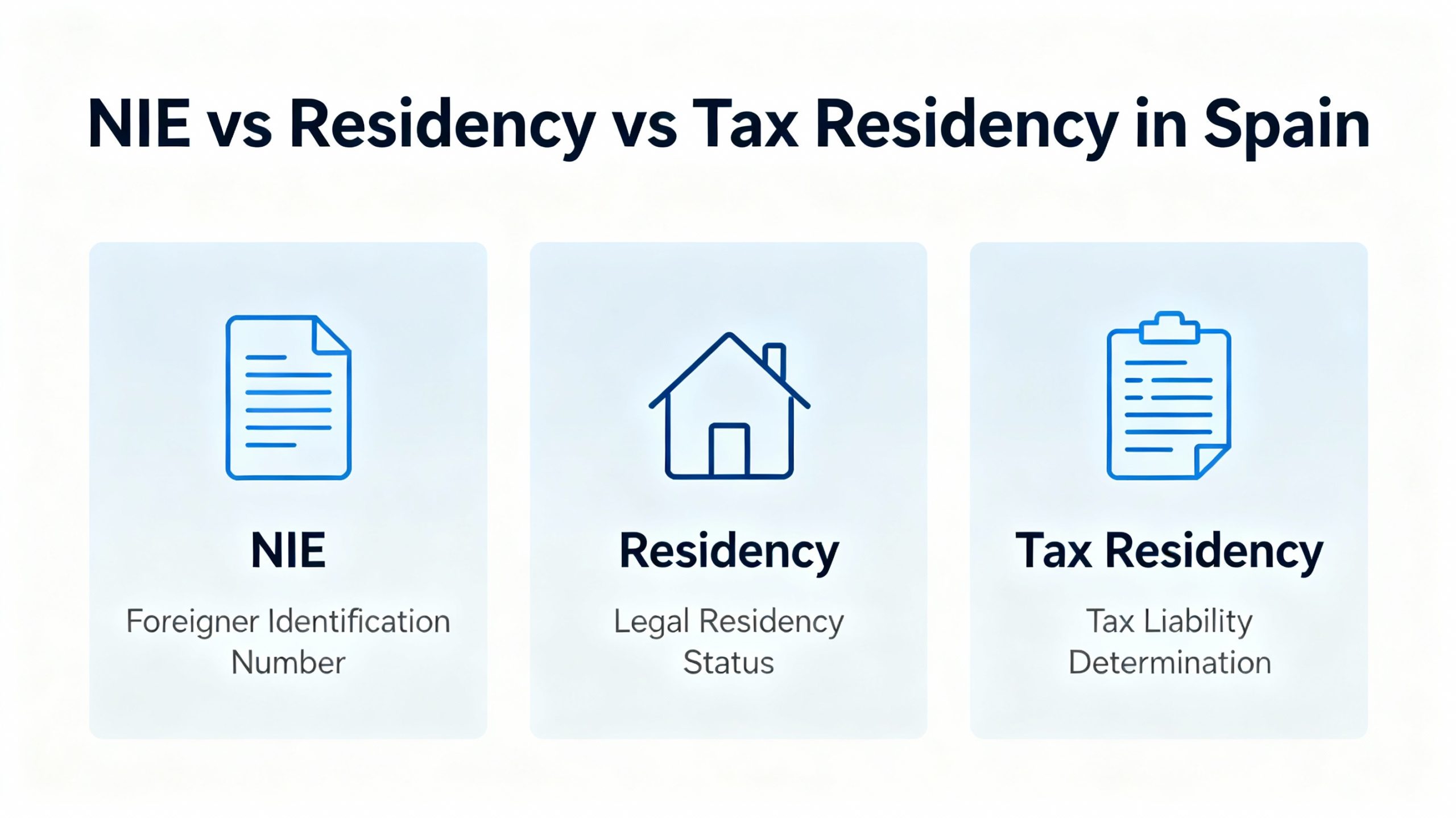
"The NIE number is your constant identifier in Spain's administrative universe. The documents containing it—certificates or residence cards—serve different legal purposes depending on your nationality and status."
Myth 4: You Can Only Get an NIE in Spain
Not anymore. Spanish consulates worldwide process NIE applications for specific purposes. If you’re buying property, starting a business, or need the number before relocating, you can often apply from your home country.
The catch? Consular offices have varying requirements and processing times. Some situations absolutely require in-person applications within Spain—particularly when connecting the NIE to immediate residency procedures.
Understanding NIE Types and Their Purposes
| Purpose | Application Location | Typical Processing | Valid For |
|---|---|---|---|
| Property purchase | Consulate or Spain | 2-6 weeks | Specific transaction |
| Employment | Within Spain | 1-3 weeks | Work-related activities |
| Business formation | Consulate or Spain | 3-8 weeks | Company registration |
| General residence | Within Spain | 2-4 weeks | Ongoing administrative needs |
Myth 5: NIE Renewal Is Mandatory
This NIE renewal myths category causes unnecessary stress. Your NIE number itself never expires and requires no renewal. Ever.
What might need renewal:
Your residence card (TIE) containing the NIE
Your authorization to work or study
Your visa category
The actual seven-digit NIE number? Permanent. It’s assigned once and follows you through every status change, address move, or life transition in Spain.
Myth 6: Getting an NIE Guarantees Tax Residency
Taxation and identification are separate legal frameworks. The NIE truth: possessing this number doesn’t automatically make you a Spanish tax resident.
Spanish tax residency typically triggers when you spend more than 183 days in Spain during a calendar year, or when your center of economic interests sits in Spanish territory. You could have an NIE for a decade while remaining a tax resident of another country—if you structure your time and affairs appropriately.
Conversely, you might become a Spanish tax resident before obtaining an NIE, though you’d need to get one quickly for filing obligations.
Myth 7: NIE Applications Are Straightforward
In theory, yes. In practice? Spanish bureaucracy has layers. Requirements vary by region, consulate, and even the official processing your application that particular day.
Common complications include:
Inconsistent document requirements between provinces
Translation and apostille requirements changing without notice
Appointment booking systems that crash regularly
Regional offices interpreting national regulations differently
Smart applicants build buffer time into their plans and prepare multiple document versions.
Myth 8: You Can Work Immediately After Getting an NIE
This dangerous assumption lands people in legal trouble. The NIE alone grants zero employment rights. Work authorization requires either:
An EU passport or registered EU citizen status
A work visa or residence permit with employment authorization
Self-employment residence authorization for entrepreneurs
Non-EU citizens working on a tourist visa plus NIE face serious consequences: deportation, fines, and future visa difficulties. Companies hiring unauthorized workers face heavy penalties too.
Real-World NIE Mistakes to Avoid
Watch for these practical errors beyond the myths:
Assuming consulate rules match in-country procedures
Forgetting to collect your NIE certificate after approval
Missing appointment deadlines (Spanish authorities rarely offer grace periods)
Using outdated forms from internet sources
Applying for the wrong NIE type for your situation
Neglecting to update your NIE details when changing address or status
Getting Reliable NIE Information
The official source for NIE requirements is Spain’s Ministry of Inclusion, Social Security and Migration, specifically the Migrations section. NIE issuance is managed by the General Commissariat for Immigration and Borders under the National Police. You can also access official information through Spain’s immigration portal and regional government websites.
Professional advisors specializing in Spanish immigration provide current, location-specific guidance. Immigration lawyers, gestoría services, and specialized relocation consultants navigate the system daily and spot pitfalls before they cause problems.
Moving Forward with Clarity
Understanding NIE myths Spain newcomers commonly encounter saves time, money, and stress. The process isn’t impossibly complex, but it requires accurate information and proper documentation.
Remember these fundamentals: your NIE is an identification number, not a residence permit. It never expires but may need reissuing for specific transactions. It provides no automatic rights to live, work, or claim tax benefits in Spain.
When planning your Spanish journey, consult current official sources and qualified professionals familiar with your specific situation. Immigration regulations shift, regional interpretations vary, and individual circumstances create unique requirements.
Frequently Asked Questions
Can I travel to Spain with just an NIE number?
No. The NIE is an identification number, not a travel document. You need a valid passport and appropriate visa (if required for your nationality) to enter Spain. The NIE becomes relevant after arrival for administrative purposes.
How long does an NIE number remain valid?
Forever. Once assigned, your NIE number never changes or expires. However, the physical certificate may need reissuing for certain transactions, and any residence permits containing your NIE have their own validity periods.
Do I need an NIE to rent property in Spain?
Typically yes. Most landlords and property management companies require an NIE for rental contracts, utility connections, and legal documentation. Some short-term rentals might accept passport numbers, but long-term housing generally requires an NIE.
Can I open a Spanish bank account without an NIE?
It’s extremely difficult. While legally possible in specific situations, most Spanish banks require an NIE as standard procedure for account opening. Non-resident accounts particularly need this identifier for tax reporting purposes.
What’s the difference between NIE and residency registration?
The NIE is your identification number. Residency registration (empadronamiento) proves your address in a specific municipality. EU citizens also complete a separate EU citizen registration. Non-EU citizens receive TIE residence cards. These are distinct processes with different legal purposes.
If I leave Spain, do I lose my NIE?
No. Your NIE number stays assigned to you permanently, even if you leave Spain and never return. However, any residence permits or registrations may lapse based on absence periods and specific visa conditions.
Can my NIE application be rejected?
Yes. Common rejection reasons include incomplete documentation, incorrect forms, unclear purpose statements, or outstanding legal issues in Spain. Most rejections can be resolved by correcting the application and reapplying with proper documentation.